
Review: Ender's Game
★★★½by William Hill
Hugo and Nebula winner Orson Scott Card made a name for himself in sci-fi with Ender's Game when it released in 1985. The hit novel spawned a series of sequels and spin-offs that Card has held close to himself since, allowing very few people access to the universe that put him in the spotlight. The fact that Ender's Game has been adapted for screen is a surprise. It is the latest product of the Actual Ender's Game label, which has seen his stories adapted to comic books from Marvel. However, it also comes when Card himself has been the target of controversy in regards to his opinion of the LGBT community. If you're reading this review, and have taken offense to his personal politics, I'll open with two statements; Ender's Game doesn't make any statements about the LGBT community. Two, here's Harrison Ford on the subject:
"I am aware of his statements admitting that the question of gay marriage is a battle that he lost and he admits that he lost it. I think we all know that we’ve all won. That humanity has won. And I think that’s the end of the story."
Also, Orson Scott Card is well documented as being a prolific asshole, beyond his personal politics. Let's gauge our opinion of his work on his story, rather than his character. That's what we're here to do, right?

Fifty years after Earth is invaded by an alien species called the Formics, mankind is preparing to fight with the buggers once again. Note, that the film doesn't often refer to them as buggers, like the book. but they are giant ant creatures. Okay, I promise that's the (next to) last time I'll nitpick about changes from the book.
Ender (Asa Butterfield) is one of many children being brought to the battle school to learn to fight the Formics. He is the third child of his family, a special privilege that few families are allowed in a time of limited breeding on Earth. He is brought to the school by Colonel Graff, played by an even grumpier Harrison Ford than I recall seeing any other recent films. Here, Graff manipulates the school's social setting to breed Ender into the perfect military strategist, and have him lead humanity to victory against the alien threat.

Before I continue, I will warn everyone that I read the book. Some of my comments will be based on comparisons from the source material. Again, I promise not to nitpick, because I have to commend Gavin Hood for his adaptation. The changes from the book are few, and the tone is kept intact.
Bringing Ender's conflict to film is difficult. Much of the novel is an internal struggle regarding Ender's social standing in the Battle School, and his relation to being a killer, rather than the empathetic person that he would like to be. We see one scene with his brother, Peter, to depict the brutal heart within the older child, and the rest of the film relies on this scene to show what he doesn't wish to become. Thankfully, the emphasis of his relationship with his sister, Valentine, remains intact, and the film depicts who he'd like to be. Graff knowing that a balance between these two characteristics would make him a great leader drives his control over Ender. This, paired with a stunning performance by Butterfield, is what keeps the story honest. This isn't the adventure film that the trailers are trying to paint. Ender's Game is more of a psychological study. Its commentaries are diverse, and while the film waters them down to some degree, the content is there to be discussed. However, with the film having a two hour run time, it doesn't get the time to say everything that the book says. For example, a great deal of the book discusses Earth politics, which inform the rest of the story. That is completely absent. Much of the ending is cut, and that content is what drives the original series of books. I understand that they can't include everything, but a scene with Mazer Rackham (Ben Kingsley) at the end of the second act sets up for a scene that is completely left out of the finale. With an otherwise tight screenplay, this rings odd to me. People who see the film without having read the book will have no issue with this oddity, but the fans might groan about it with me. Regardless of that fact, the finale rings true to the book, even if it feels like it cuts the film off a little too soon.
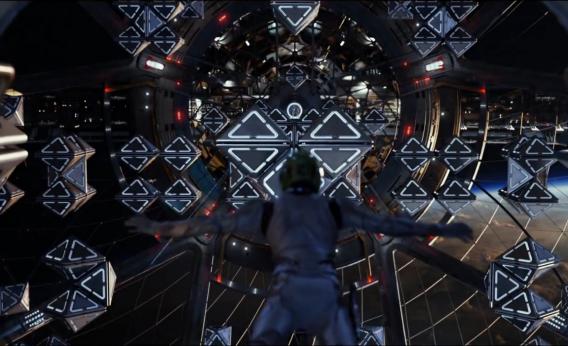
Gavin Hood has redeemed himself for X-Men Origins with Ender's Game. The camera never interferes with the story, and every scene carefully collects the right information, and gives the right sensation of living on a space station. The set design is militant, with little color, and only depicts a few touches of generic sci-fi, like LED strip lighting and striped colors to direct staff and soldiers alike to their destinations. Most impressively, the Battle Room seems pulled directly from the pages of the book. The final stretch of the film is the most beautifully imagined, and contains some of the best space combat I've seen since the Star Wars prequels. However, given the nature of the film, these scenes aren't designed for intense stimulation. Again, the tone of the book is here. I'm going to leave it at that... The score is definitely a weak spot in the mix. While laser fire and mechanical hum are impressive, and fill the soundscape, the music is reminiscent of generic bassy bombast and thinned strings. It's not anthemic, it's completely unmemorable, and is ultimately absent. It didn't need to be triumphant, or filled with overt dirges, but it could have filled the air with something, rather than being there for the sake of booking the prerequisite orchestra. Most impressive of all is the cast. Asa Butterfield reminds us that child actors can impress, and still make us believe that they will have a career when they grow up. I'm thrilled to see Harrison Ford back in space, and he walks a fine line as Graff, remaining sympathetic while performing as the inhumane military leader. Ben Kingsley isn't in the film long enough to stand out as Rackham, but as you'd expect from Kingsley, he does well enough when he needs to. Sadly, that's only two or three scenes from the mid-point to the finale. Most of the teens that were cast in the film perform well, but Bonzo (Moises Arias)is a bit weaselly for my tastes.
I'm not sure if Ender's Game is destined to become the next sci-fi blockbuster franchise on everyone's mind, but it certainly is an impressive adaptation of one the genre's finest works. The fact that it's source material is more about a child's psychology than an adventurous romp through space with Han Solo is likely to throw some viewers off. It's not a film that is designed for fun. There are questions being asked by the narrative, and while they aren't given a lot of room in the context of the coming-of-age/action film, they are there for discussion. I'm also not sure how well Hollywood will handle the sequels. The 1986 sequel, Speaker for the Dead, is so far removed from Ender's Game that it would be a nightmare to pitch as a sequel. Also, Card doesn't want to see it made into a film, claiming that it is "unfilmable". I guess that we should at least appreciate that he doesn't want to cash in on everything he's made.
Even if he is a prick.

