Pages

Showing posts with label Summit. Show all posts

Friday, November 22, 2013

Review: Catching Fire

by William Hill
★★★½

From the ashes of the Twilight...thing (I refuse to call it a saga), comes The Hunger Games trilogy, the latest young adult fiction sensation which has been compared to Battle Royale, Lord of the Flies, and other subject matter far darker than the young adult label is purported to cover. I read the first volume of the trilogy when I got my Nook last year, since the freebie option was either this, or the aforementioned cheap anti-erotica novel, I opted for the book where teenagers kill each other. Considering the Stephanie Meyers blurb on the back cover, my blood was good and frosty when I opened the glorified HTML file that was siting in solitary on my new eReader, I was surprised to find the story of a strong young woman sticking it to a society of hedonists, while trying to survive a free-for-all battle before getting into a love triangle of what in the buggering hell is this nonsense?

Hardly indicative of the themes of nature of the film.

For those of you who are reading this and still questioning why people are into The Hunger Games franchise, allow me to assuage certain fears. No, this isn't about a love starved idiot who pines for two men while a far greater conflict gets shoved into the background. In fact, the entire love triangle thing was shoved into the first book/film. I'll wrap up my discussion of the first film by saying that it was a well told story with fine performances from most of the cast, and some of the most nauseating photography ever designed to conceal brutal violence. I was thrilled to hear that Gary Ross wasn't returning to shoot the follow-up, and that they were leaving the broken tripod back in the equipment truck. So how does the second act of Suzanne Collin's trilogy translate to film?

Well, I didn't get around to reading this book yet, so there will be no nitpicking.


Catching Fire picks up less than a year after the events of the first film, and Katniss Everdeen (Jennifer Lawrence) is still trying to recover from the grim happenings at the previous year's Hunger Games. Her relationship with Thor's brother, Gale (Liam Hemsworth) is a little bit icy after her claiming her love to Peeta (Josh Hutcherson), and rebellion is on the air. Do you see how long it took me to get to the rebellion part? Well, thankfully they dialed this back quite a bit for the sequel, and it doesn't take long before Katniss and Peeta are off to tour the districts and talk about their victory, and watch people get killed, riots break out, and how their actions in the games are spreading hope among the downtrodden people of the other districts. This doesn't sit well with President Snow (Donald Sutherland), who aims to use the popularity of Ms. Everdeen to silence the cries of revolution. What follows is a thrilling look at how people unite under symbols, and how the media is used to mask the dark world events happening right under our noses. It's smart stuff, however given the nature of the series popularity, I wonder if any of the concepts being introduced in the film are being noticed by the audience it is selling to. The score stirs and stings accordingly, and is decent enough to warrant mentioning. I'd like to have heard the mockingjay call used a melodic cue, but I didn't notice such touches of leitmotif upon my first viewing.

He just wouldn't stop asking them to play the music from Tron: Legacy...
Before I get philosophical, I have to celebrate how well Francis Lawrence has improved on what was done in the first film. The photography is far more competent, and doesn't shy away from the violence by quickly moving it from side to side. Sure, it's not packing Battle Royale levels of blood and gore, but it does a far better job of keeping the worst stuff from PG eyes. The visuals are usually impressive, though some of the CGI is less than attractive. When the Quarter Quell kicks off, and the action picks up, there is a scene with monkeys...it isn't as bad as Kingdom of the Crystal Skull, but it's definitely not a pretty sight compared to the bloom-lit beauty of glossy trains, 1% society, and some glorious landscapes. Extravagant costume design in the Capitol scenes continues to stand out, with some truly eye-catching scenes that are designed to remind us of the gap in the social strata, but still draw attention to the visual design of the film in a great way.


Catching Fire does give the world another reason to say how genuinely talented Jennifer Lawrence really is. While this isn't the meatiest content that she's dealt with (see Winter's Bone, and do it soon), she carries herself through every scene with aplomb. It's easy to relate to her troubles, be it the PTSD behaviors she delivers early in the film, or the stark middle-finger-raising rebelliousness which defines her character in the previous film, as well as the late second act of Catching Fire, she excels as Katniss. Supporting this luminary are decent performances from Hemsworth and Hutcherson. However, Woody Harrelson is still a lot of fun as Woody Harrelson, tumbling through the film as a brilliant raging alcoholic. Donald Sutherland is a fantastic villain, remaining intimidating throughout the film, providing a great specter to hover in the atmosphere.

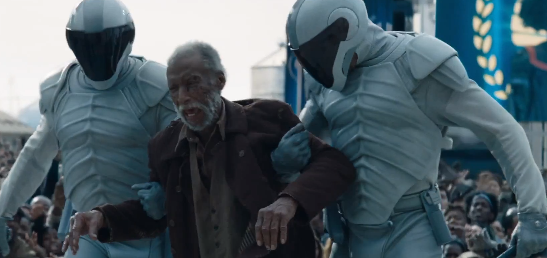
Ummm...what?
I can't help but call the audience out in regards to the tonal content of the film. Let's start with this little oddity; I work at a drug store, and about two months ago, we received a shipper from Cover Girl marked Catching Fire, and I was more than sickened to find "District Twelve Look" makeup inside. It's blatant mass marketing using a popular brand to sell eyeliner when the source material is starkly anti-commercial. Let's pick this apart: both The Hunger Games and Catching Fire clearly illustrated that there was a deep chasm in the social strata between the districts and the Capitol, where people are starving while they go to work in the mines, but the rich are living extravagant lives of sheer hedonism, where they consume vast amounts of food, and then drink a small beverage that makes them sick so that they can continue to eat. When the distributor breaks out the marketing machine that allows you to buy the look of people who are starving and mining for coal, you begin to wonder what people are actually drawing from this series. Let's take it to the character. Katniss is a strong, independent teenager who would sneak out of the city to hunt so she could better feed her family. She put her name in the drawings for the games several times over to get more bread. I was already irritated that she was pushed into a love triangle in the second act of the book because it didn't make any damned sense. She becomes the icon of rebellion among the poor and downtrodden, because she is rebellious. She doesn't conform to what is expected of her by President Snow and the people of the Capitol. So tell me, how does this films fandom deal with putting on colorful Hunger Games branded eyeliner when thinking of this character as rebellious and anti-conformist?


The short answer? They don't. Despite the best efforts of the books and the film, which both depict the social strata of Panem, the idea of peoples as symbols for rebellion, and that this strong young woman could fight and survive against all odds, the thing I heard most people reacting to while the movie was going was the damned love story. Cynics who are unsure of why people bother with the young adult love story, allow me to tell you that Catching Fire is a strong film, with bold statements to make about cult of personality, how the media projects people, and how those personalities can be illusions. Francis Lawrence has made up for the sins of The Hunger Games, and delivered one hell of a second act in Catching Fire. Check out the first one if you haven't, and go see Catching Fire. It's a great theatrical experience, and a movie that you'll discover is a lot more than it's marketing suggests.

Baby, it ain't over til it's over.
Let's see how Mockingjay translates from the oft panned book to film when it comes out next year. In two parts. Because that's how we do the last part of equally sized books when we adapt them these days.


Sunday, November 3, 2013

Review: Ender's Game

Review: Ender's Game

★★★½
by William Hill

Hugo and Nebula winner Orson Scott Card made a name for himself in sci-fi with Ender's Game when it released in 1985. The hit novel spawned a series of sequels and spin-offs that Card has held close to himself since, allowing very few people access to the universe that put him in the spotlight. The fact that Ender's Game has been adapted for screen is a surprise. It is the latest product of the Actual Ender's Game label, which has seen his stories adapted to comic books from Marvel. However, it also comes when Card himself has been the target of controversy in regards to his opinion of the LGBT community. If you're reading this review, and have taken offense to his personal politics, I'll open with two statements; Ender's Game doesn't make any statements about the LGBT community. Two, here's Harrison Ford on the subject:

"I am aware of his statements admitting that the question of gay marriage is a battle that he lost and he admits that he lost it. I think we all know that we’ve all won. That humanity has won. And I think that’s the end of the story."

Also, Orson Scott Card is well documented as being a prolific asshole, beyond his personal politics. Let's gauge our opinion of his work on his story, rather than his character. That's what we're here to do, right?


Fifty years after Earth is invaded by an alien species called the Formics, mankind is preparing to fight with the buggers once again. Note, that the film doesn't often refer to them as buggers, like the book. but they are giant ant creatures. Okay, I promise that's the (next to) last time I'll nitpick about changes from the book.

Ender (Asa Butterfield) is one of many children being brought to the battle school to learn to fight the Formics. He is the third child of his family, a special privilege that few families are allowed in a time of limited breeding on Earth. He is brought to the school by Colonel Graff, played by an even grumpier Harrison Ford than I recall seeing any other recent films. Here, Graff manipulates the school's social setting to breed Ender into the perfect military strategist, and have him lead humanity to victory against the alien threat.


Before I continue, I will warn everyone that I read the book. Some of my comments will be based on comparisons from the source material. Again, I promise not to nitpick, because I have to commend Gavin Hood for his adaptation. The changes from the book are few, and the tone is kept intact.

Bringing Ender's conflict to film is difficult. Much of the novel is an internal struggle regarding Ender's social standing in the Battle School, and his relation to being a killer, rather than the empathetic person that he would like to be. We see one scene with his brother, Peter, to depict the brutal heart within the older child, and the rest of the film relies on this scene to show what he doesn't wish to become. Thankfully, the emphasis of his relationship with his sister, Valentine, remains intact, and the film depicts who he'd like to be. Graff knowing that a balance between these two characteristics would make him a great leader drives his control over Ender. This, paired with a stunning performance by Butterfield, is what keeps the story honest. This isn't the adventure film that the trailers are trying to paint. Ender's Game is more of a psychological study. Its commentaries are diverse, and while the film waters them down to some degree, the content is there to be discussed. However, with the film having a two hour run time, it doesn't get the time to say everything that the book says. For example, a great deal of the book discusses Earth politics, which inform the rest of the story. That is completely absent. Much of the ending is cut, and that content is what drives the original series of books. I understand that they can't include everything, but a scene with Mazer Rackham (Ben Kingsley) at the end of the second act sets up for a scene that is completely left out of the finale. With an otherwise tight screenplay, this rings odd to me. People who see the film without having read the book will have no issue with this oddity, but the fans might groan about it with me. Regardless of that fact, the finale rings true to the book, even if it feels like it cuts the film off a little too soon.


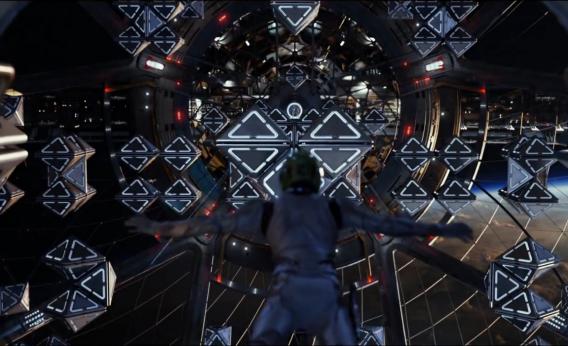
Gavin Hood has redeemed himself for X-Men Origins with Ender's Game. The camera never interferes with the story, and every scene carefully collects the right information, and gives the right sensation of living on a space station. The set design is militant, with little color, and only depicts a few touches of generic sci-fi, like LED strip lighting and striped colors to direct staff and soldiers alike to their destinations. Most impressively, the Battle Room seems pulled directly from the pages of the book. The final stretch of the film is the most beautifully imagined, and contains some of the best space combat I've seen since the Star Wars prequels. However, given the nature of the film, these scenes aren't designed for intense stimulation. Again, the tone of the book is here. I'm going to leave it at that... The score is definitely a weak spot in the mix. While laser fire and mechanical hum are impressive, and fill the soundscape, the music is reminiscent of generic bassy bombast and thinned strings. It's not anthemic, it's completely unmemorable, and is ultimately absent. It didn't need to be triumphant, or filled with overt dirges, but it could have filled the air with something, rather than being there for the sake of booking the prerequisite orchestra. Most impressive of all is the cast. Asa Butterfield reminds us that child actors can impress, and still make us believe that they will have a career when they grow up. I'm thrilled to see Harrison Ford back in space, and he walks a fine line as Graff, remaining sympathetic while performing as the inhumane military leader. Ben Kingsley isn't in the film long enough to stand out as Rackham, but as you'd expect from Kingsley, he does well enough when he needs to. Sadly, that's only two or three scenes from the mid-point to the finale. Most of the teens that were cast in the film perform well, but Bonzo (Moises Arias)is a bit weaselly for my tastes.

I'm not sure if Ender's Game is destined to become the next sci-fi blockbuster franchise on everyone's mind, but it certainly is an impressive adaptation of one the genre's finest works. The fact that it's source material is more about a child's psychology than an adventurous romp through space with Han Solo is likely to throw some viewers off. It's not a film that is designed for fun. There are questions being asked by the narrative, and while they aren't given a lot of room in the context of the coming-of-age/action film, they are there for discussion. I'm also not sure how well Hollywood will handle the sequels. The 1986 sequel, Speaker for the Dead, is so far removed from Ender's Game that it would be a nightmare to pitch as a sequel. Also, Card doesn't want to see it made into a film, claiming that it is "unfilmable". I guess that we should at least appreciate that he doesn't want to cash in on everything he's made.

Even if he is a prick.