Pages

Showing posts with label Willem Dafoe. Show all posts

Monday, July 28, 2014

Review: A Most Wanted Man

by. Trevor Kirkendall
★★

The one thing I couldn’t help but think about the entire time I watched “A Most Wanted Man” was that this would be one of the last times we’d see Philip Seymour Hoffman. I try not to play favorites when it comes to movies and my reviews, but it’s very difficult for me to do that when it involves Hoffman. I always thought he was one of the most talented actors working in Hollywood. Had he not succumbed to his addictions, perhaps we could have had the “greatest of all time” conversation later in his life. At minimum, we could have had the “Mount Rushmore of Acting” conversation with Hoffman’s name included. Alas, “A Most Wanted Man” will be one of the last times we go to the movies to see something new from Hoffman.

In “A Most Wanted Man” Hoffman plays Günther Bachmann, a spy operating out of Hamburg, Germany. Title cards inform us that Germans are on top of intelligence in the years following 9/11 in hopes that the errors made prior to the attacks don’t happen again. Bachmann and his group pick up on some intel that a Chechen Muslim named Issa (Grigoriy Dobrygin) has entered Germany and they want to know why.

Issa seeks the help of a lawyer named Annabel Richter (Rachel McAdams) who is sympathetic to foreigners looking to leave their home countries (terrorist or not). Issa is trying to get some money out of an account his father has at a bank run by Tommy Brue (Willem Dafoe). Bachmann and his team watch from afar trying to put the pieces together and figure out exactly what Issa has come to Germany to do. Of course, whenever terrorists are involved, the Americans want to have stand over everyone’s shoulders, thus Bachmann has to play nice with a diplomat, Martha Sullivan (Robin Wright), from the American Embassy in Berlin.

“A Most Wanted Man” shares many of the same characteristics with other films in the spy thriller genre. It’s very quiet, the sets are dimly lit, and the script is full of much more plot instead of story. These parts all can work well together as evident in other great spy films such as “Tinker Tailor Soldier Spy,” based on a novel by John le Carré as is “A Most Wanted Man.” Unfortunately what we have here is a film that’s a whole lot of spy and not enough thriller.

Most spy movies are very patiently paced to give the audience a chance to unlock the enigma at the same speed as our protagonists. Sometimes, they may seem like they’re running long, but most of the time the film’s climax makes the pace worthwhile. With “A Most Wanted Man,” I feel that the amount of content building in the plot is very light by comparison to other spy films. The screenplay, by Andrew Bovell, gets bogged down by consistently repeating many of the same plot points we’ve already heard. This is a classic case where the film could have easily been trimmed by around 20 minutes or so and would have been much more effective.

It appears, they leave this excess filler in the film to allow for character development; unfortunately, the focus is on the wrong people. I wanted to know more about Bachmann and his backstory. What little comes up is usually in conversations between he and Sullivan, yet it’s never explored to any depth. Instead, the focus is directed toward Annabel and Issa, which ends up doing little in terms of the story.

Director Anton Corbijn has already shown his proficiency within the spy thriller genre with the excellent 2010 film “The American.” But, with “A Most Wanted Man,” Corbijn seems to have lost sight about what works and what doesn’t when it comes to this very specific genre. Hoffman’s immaculate ability to lose himself in a character is enough to salvage an error filled screenplay, but a director still needs to do his part. In a film that’s all-plot-and-little-story, Corbijn needs to shift his focus off the characters and into the plot. This is something he’s done before with “The American” but fails to achieve here.

That being said, Hoffman is once again outstanding in his performance. That is no surprise. What is new is that this is it for him (other than the next two films in “The Hunger Games” series). Yet while outstanding, this is far from his best work. 

On another positive note, the film is pieced together with razor sharp proficiency thanks to industry veteran Claire Simpson who has already one won Oscar (“Platoon”) and cut another film from a le Carré novel (“The Constant Gardner”).

“A Most Wanted Man” is where we say goodbye to one of the legends of acting. It’s just too bad it’s not a better film. Fans of spy thrillers should enjoy it though, even if the pace is much more patient than a typical film in the genre. Other than Hoffman, I’m not sure why there would be much of a reason to go out of your way to see this one.


Monday, March 31, 2014

Review: The Grand Budapest Hotel

by Trevor Kirkendall
★★★★

Take note, Hollywood: originality is alive and well if you’re willing to look for it. Director Wes Anderson is full of originality, from his stories to his style. “The Grand Budapest Hotel” is his latest film and it fits perfectly into his body of work that’s already been highly regarded and decorated.

“The Grand Budapest Hotel” is a story about the adventures of Monsieur Gustave H. (Ralph Fiennes), concierge of the Grand Budapest Hotel in the fictional Republic of Zubrowka. M. Gustave is a dedicated servant to the hotel who is loved by all his guests, specifically the older blonde women who visit the hotel just for him. He’s most fond of Madame D. (Tilda Swinton) who thinks her current stay at the Grand Budapest will be her last time seeing M. Gustave.

Seeing all the events unfold (and acting as our story teller in the form of F. Murray Abraham) is young Zero Moustafa (Tony Revolori) who is a junior lobby boy in training. Gustave takes him under his wing and the two become friends. About a month later, news arrives that Madame D. has died. Gustave takes Zero to pay their respects. When they arrive at her estate, Gustave finds out that she has bequeathed him a rare painting called Boy with Apple. It’s priceless. But Madame D’s son Dmitri Desgoffe-und-Taxi (Adrien Brody) doesn’t think he deserves it. Dmitri sends his henchman, J.G. Jopling (Willem Dafoe) out on a dastardly mission.

Soon, Gustave is accused of murdering Madame D. and is arrested by Inspector Henckels (Edward Norton). But the math doesn’t add up. All the evidence points to M. Gustave murdering her, but he didn’t do it. It’s up to Gustave and Zero to figure out the mystery so his name can be cleared. Along with help from Zero’s beautiful young bride-to-be Agatha (Saoirse Ronan), they all have to work together or else Gustave will be an innocent man locked away in prison.
 
The plot is, of course, much bigger than that. In typical Wes Anderson fashion, the story takes on a larger than life personality. “The Grand Budapest Hotel” is completely ludicrous, and I mean that in the best possible sense. It’s instantly welcoming and keeps you drawn in thanks to all the over-the-top and farcical characters. Anderson carries us from one wild chapter to the next with his fast paced script and style.

Anderson is in a class all of his own. He might even be a genre all of his own. To compare him to anyone else would be useless. His films are one-of-a-kind from the originality of the stories, the elaborated character types, deliberate camera movements and his lush use of music (thanks here to the fantastic compositions of Alexandre Desplat). Yes, there are many other filmmakers that have these types of trademarks, but not in the sense that Anderson uses them. He transcends the meaning of the term “filmmaker;” he’s an auteur.

While “The Grand Budapest Hotel” doesn’t contain any outlooks on life that will move you and rattle your emotions to the core, it is highly entertaining and exceedingly fun to watch. Anderson opted to tell the story in parts rather than acts. Five parts are bookended by a prologue and epilogue. This helps keep the film paced at a manic speed. Anderson claims the works of Stefan Zweig - an Austrian writer who was highly renowned around the world during the 1930s - inspired the film. He even creatures a caricature of Zweig – to an extent – with Tom Wilkinson and Jude Law portraying the character (simply credited as The Author).

The film is also bursting at the seams with Anderson regulars, albeit in small roles. Jason Schwartzman, Owen Wilson and Bill Murray all make appearances. There’s also plenty of room for other well known actors to make an appearance, such as Jeff Goldbloom, Mathieu Amalric, Harvey Keitel, Léa Seydoux and Bob Balaban to name a few. It’s hard to pin down one role in particular who carries the film; everyone is so much fun to watch.

Fiennes, more than anyone else, is magnificent. He’s known more for his serious or Elizabethan-era roles, but here he plays straight comedy and carries it with great ease. We already know he can play the high society role well and here he completely embellishes it. He’s fast-talking and uses a lot of big words that don’t really fit into today’s vernacular. I also liked newcomer Tony Revolori. He seemed confident and in command of his role despite standing opposite such a renowned actor such as Fiennes.


“The Grand Budapest Hotel” is a film that showcases Anderson at the top of his craft. While this film certainly won’t be for everybody, it is probably Anderson’s most accessible movie. The quirks that are so closely associated with Anderson’s work are on full display here which could turn some viewers off. I implore those would-be naysayers to take a chance on something unusual and offbeat such as this. This is one of Anderson’s finest works to date, and should also go down as one of the finest films of the year. 

Saturday, December 7, 2013

Review: Out of the Furnace

by William Hill
★★★½

Out of the Furnace comes to us from Scott Cooper, director of 2009's Crazy Heart. I never saw Crazy Heart, and I didn't have an inkling of hype for Out of the Furnace. With Ridley Scott and Leonardo DiCaprio producing, I am also surprised that there wasn't more fanfare for this one. Still, I went into this with light expectations, and given the middling response from many critics, I didn't know what I was going into. The synopsis seemed generic, and the premise a bit too stereotypical of modern dramas.


The official story is that Russell Baze, played by Christian Bale, pursues a dangerous crime ring to find his brother after he's gone missing. While this paints a picture of a taut thriller where Bale fights a bunch of thugs, it really isn't anything like that. In fact, the advertised missing brother plot doesn't even go into play until over an hour after the film starts.

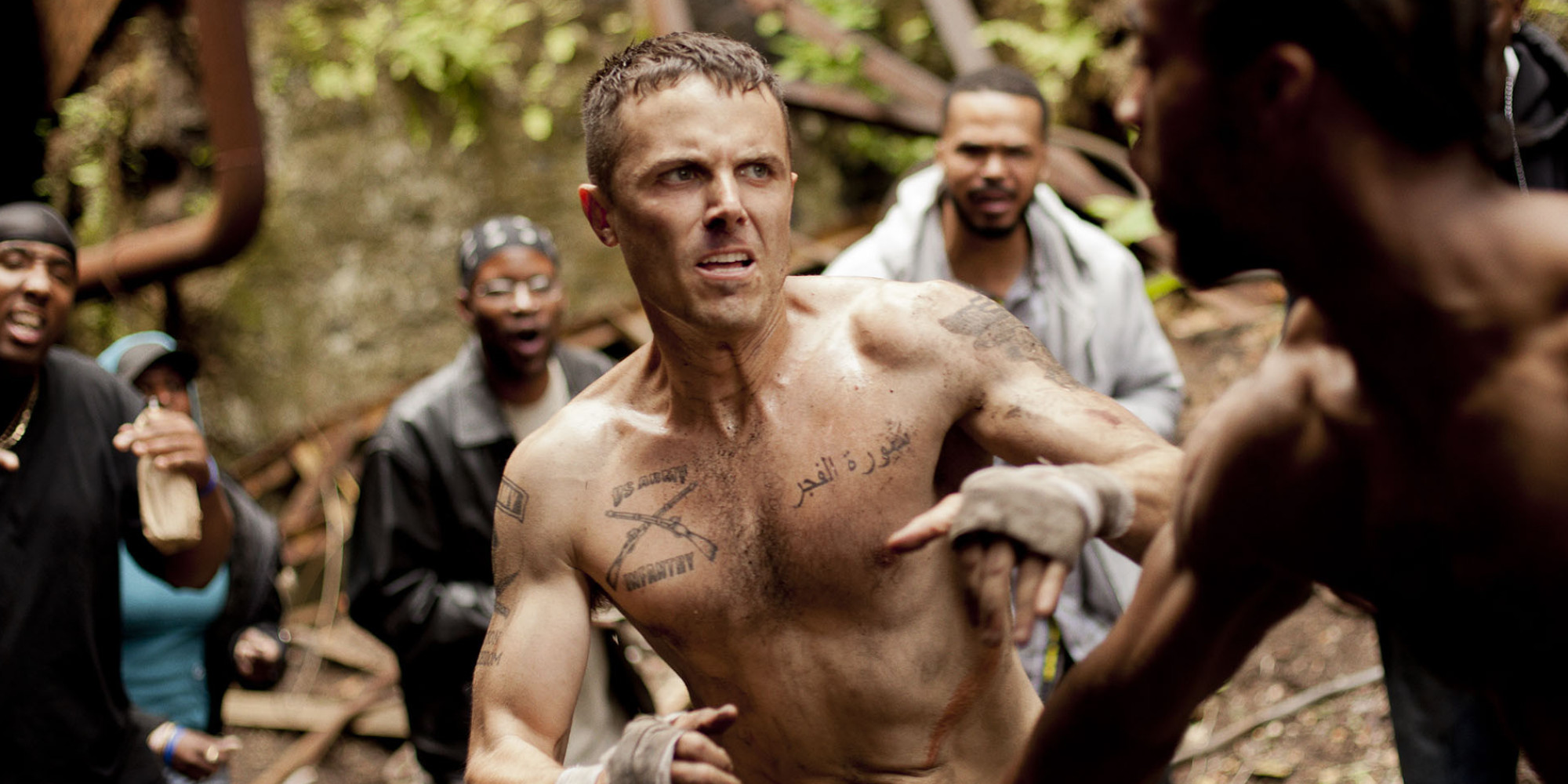
The film opens with an comfortable scene where Harlan DeGroat (Woody Harrelson), is at a drive in theater with his date. He turns into Woody Harrelson, and argues with his date, before beating a man, and walking out. Cut to Russel's introduction, working in a steel mill in Pennsylvania. He leaves work, and find that his brother, Rodney (Casey Affleck), is gambling on races, and in debt to a local loan shark. There is an immediate connection between the two, and their relationship is setup in mere seconds. Russel pays part of Rodney's debt to John Petty (Willem Dafoe) some time later, and we even meet Russel's girlfriend Lena (Zoe Saldana) in between. It's a tightly paced first act that lands Russel in prison for drunk driving. When he is release, Russel learns that Rodney has gotten involved with underground fighting to pay off his debts to Petty.

I had this horrible dream that I was dating someone who couldn't emote.
If I have any issue with the story, it is that the first act can seem a little flaky at first. With Russel ending up in jail only minutes into the film, and the fact that Russel barely seems drunk when he leaves the bar, the whole movie doesn't seem to know what it is doing for a few minutes. Thankfully, by the time the second act finally finds a pulse, the rest of the film finds a way to make the first act seem worthwhile. However, this still makes the first act weak, because it shouldn't rely on the second act to give it purpose. I will say that the finale is intensely satisfying.

What I find strange is that Out of the Furnace is marketed as a revenge film, but it has more to do with self-absolution following tragedy. Both Russel and Rodney are dealing with their ghosts. While Russel deals with the deaths he caused in his car accident, Rodney is the survivor of four tours of duty in Iraq, and carries gruesome memories that disrupt his performance in fights that he is supposed to be throwing. It's a taut drama, but hardly the thriller that the marketing illustrates.

The first rule of Fight Club is please stop making Fight Club jokes.
Out of the Furnace is probably the most earthy film I've seen this year. A muted color palette tinged with hues of warm yellow are cast on dark colored walls and living areas, and there are moments of high contrast lighting. It's got this brilliant early seventies vibe, all the further augmented with soft focus and a lot of steady handheld photography. There are a few shots that I felt were less than inspired, but aside from those nitpicks, it's a gorgeously shot film. Juxtaposed with a subtle soundtrack of simple guitar lines and sustaining woodwinds and light strings, there are a lot of warm moments with Russel, and sequences of stark desperation with Rodney. I have to give special recognition to the inclusion of Release by Pearl Jam early in the film. In retrospect, that should have told me exactly what kind of movie I was dealing with.

In all seriousness, these guys did more acting in this scene
than what's contained in an entire stack of Man of Steel blu-rays.
Out of the Furnace sees one of Christian Bale's finest performances to date, spoken with great care and more heart than I've ever seen him put into a role. Willem Dafoe proves to slip outside of the loan shark stereotype, and prove to be more likable than Casey Affleck, who still performed extremely well. Woody Harrelson played the typical Woody Harrelson act, but it's still an intense and disturbed performance, and shouldn't be discounted. The writing is top notch, and the experience overall is far more memorable than I'd expected. With a lot of competition in the theaters right now, I can still say that Out of the Furnace is among the best on the big screen right now.