Pages

Showing posts with label Woody Harrelson. Show all posts

Friday, November 21, 2014

Review: The Hunger Games: Mockingjay - Part I

by Trevor Kirkendall
★★★ 

For a big budget and over-produced film with “Hollywood” written all over it, “The Hunger Games: Mockingjay – Part I” is a well put together film, rarely lacking in dull moments. I say “rarely” because there are a few yawn-inducing moments here or there that probably could have been easily left out. But overall, there’s a bit more genuine emotion coming through here than you normally would see from they typical crap the studios have been producing lately, which is nice.

“Mockingjay – Part I” picks up almost immediately where “Catching Fire” left off. District 12 is gone. Katniss Everdeen (Jennifer Lawrence) is now hiding out in District 13 with former game designer Plutarch Heavesbee (Philip Seymour Hoffman), former Hunger Games victor Finnick Odair (Sam Claflin), romantic interest Gale (Liam Hemsworth) and her former sponsor Haymitch (Woody Harrelson). Her mom and sister are also there. But not Peeta (Josh Hutcherson). He’s being held captive in the Capitol.

The story revolves around Katniss becoming the Mockingjay, a poster child for the uprising among the various districts. The plan is put in motion by District 13 President Alma Coin (Julianne Moore). She sends Katniss out into the bombed out Districts with a propaganda filmmaker from the Capitol, Cressida (Natalie Dormer) to get some footage of her that can be used to rally the other Districts into fighting for the rebellion. But Katniss is cautious of her actions because she knows the evil President Snow (Donald Sutherland) has Peeta in a jail cell somewhere and torturing him. She doesn’t want him to die.

The biggest problem I have with this movie can be summed up with the title: “The Hunger Games: Mockingjay – Part I.” We can’t just get an adaption from a book anymore; it has to be a series, or at the very least, it needs to have “series potential.” So all those good books you read that begin and end between the hardcover, forget ever seeing those on film. Unless some poor screenwriter can somehow concoct a sequel. That’s really the only reason Hollywood screenwriters exist anymore. What a pity.

So we have a series of books: The Hunger Games Trilogy. The trilogy has two great novels, and one crappy novel. “Mockingjay” is the crappy one. I’m sorry if you liked it, but I had to force myself to finish it. We’ve already seen the first two films made from the first two books, which were both pretty good movies. But now we get two movies out of this one crappy book. And for what reason? Because they know you’re going to pay double to see it.

After watching this film and investing two hours into the story, we will now have to wait another 12 months before we get to see the cinematic version of the second half of the series’ worst installment. I mean, if they really wanted to split a book into two parts and make four movies, “Catching Fire” would have been the appropriate candidate. But instead, we get this one, the book with one of the most wretched conclusions of any book I’ve ever read.

But it’s unfair of me to judge the film itself on the greedy aspirations of the executives at Lionsgate. Despite having three separate writers credited here (Peter Craig and Danny Strong on the screenplay and author Suzanne Collins credited with “adaptation” whatever that means – I’ve never seen anyone credited like that), the story is balanced out pretty well. Aside from the aforementioned yawn-inducing moments, the script never feels overinflated. It never feels like filler was jammed in just so that the story could be stretched out into two full-length movies. It actually works well, and yes, I am quite surprised by that, given the source material.

Julianne Moore is a nice addition to the cast this time around, even though her role is reduced to just a woman sitting there during some scenes and delivering morale-boosting speeches to her followers in others. I pictured President Coin with a little more drive behind her. Apparently that’s now how director Francis Lawrence saw the character. Oh well. Moore is always so solid and it’s nice to see her getting a chance to showcase her talents for what will no doubt be a large audience. But of course, the star of the film is none other than Jennifer Lawrence. This is the role that made her a mega-Hollywood superstar, after all.

The story this time around focuses more on her struggles of leading an entire nation in revolution rather than just hanging out in the forest or on a beach trying to avoid death. Here, we finally get to see a little bit more about what kind of a person Katniss Everdeen really is. I always felt that the love triangle between her, Peeta and Gale was a bit ridiculous and was designed to be overly complex just for complexity’s sake. But a lot more goes into her and her feelings toward her two suitors this time around. And Lawrence absolutely nails it.

She runs through the emotional gauntlet as well as she’s ever done. For my money, she’s never been better than her breakout role in 2010’s “Winter’s Bone.” Even her Oscar winning performance can’t touch that one. After watching “Mockingjay – Part I,” I still think my assessment is true, but who could have predicted a performance this good from a movie like such as this? Not me.


I had already written this film off when I went into it, but I must admit to being impressed. But the unfortunate thing is, I don’t feel like I watched a whole movie. A story is a beginning, middle and end. This is just a middle – a two hour second act. The third act is still a year away. I can’t support the studio executives in their blatant cash grab attempts but putting unnecessary yearlong breaks between movies like this. And it’s not going to stop anytime soon either. But, I guess I can’t really complain too much if the movies are good, especially from the studios. “Mockingjay – Part I” isn’t bad. It just shouldn’t be two parts. And while there might be a little bit more action in “Part II,” I just can’t get psyched up for it. At least not right now. I guess I’ll conclude my “Mockingjay” review next November. Tune in then.

Saturday, December 7, 2013

Review: Out of the Furnace

by William Hill
★★★½

Out of the Furnace comes to us from Scott Cooper, director of 2009's Crazy Heart. I never saw Crazy Heart, and I didn't have an inkling of hype for Out of the Furnace. With Ridley Scott and Leonardo DiCaprio producing, I am also surprised that there wasn't more fanfare for this one. Still, I went into this with light expectations, and given the middling response from many critics, I didn't know what I was going into. The synopsis seemed generic, and the premise a bit too stereotypical of modern dramas.


The official story is that Russell Baze, played by Christian Bale, pursues a dangerous crime ring to find his brother after he's gone missing. While this paints a picture of a taut thriller where Bale fights a bunch of thugs, it really isn't anything like that. In fact, the advertised missing brother plot doesn't even go into play until over an hour after the film starts.

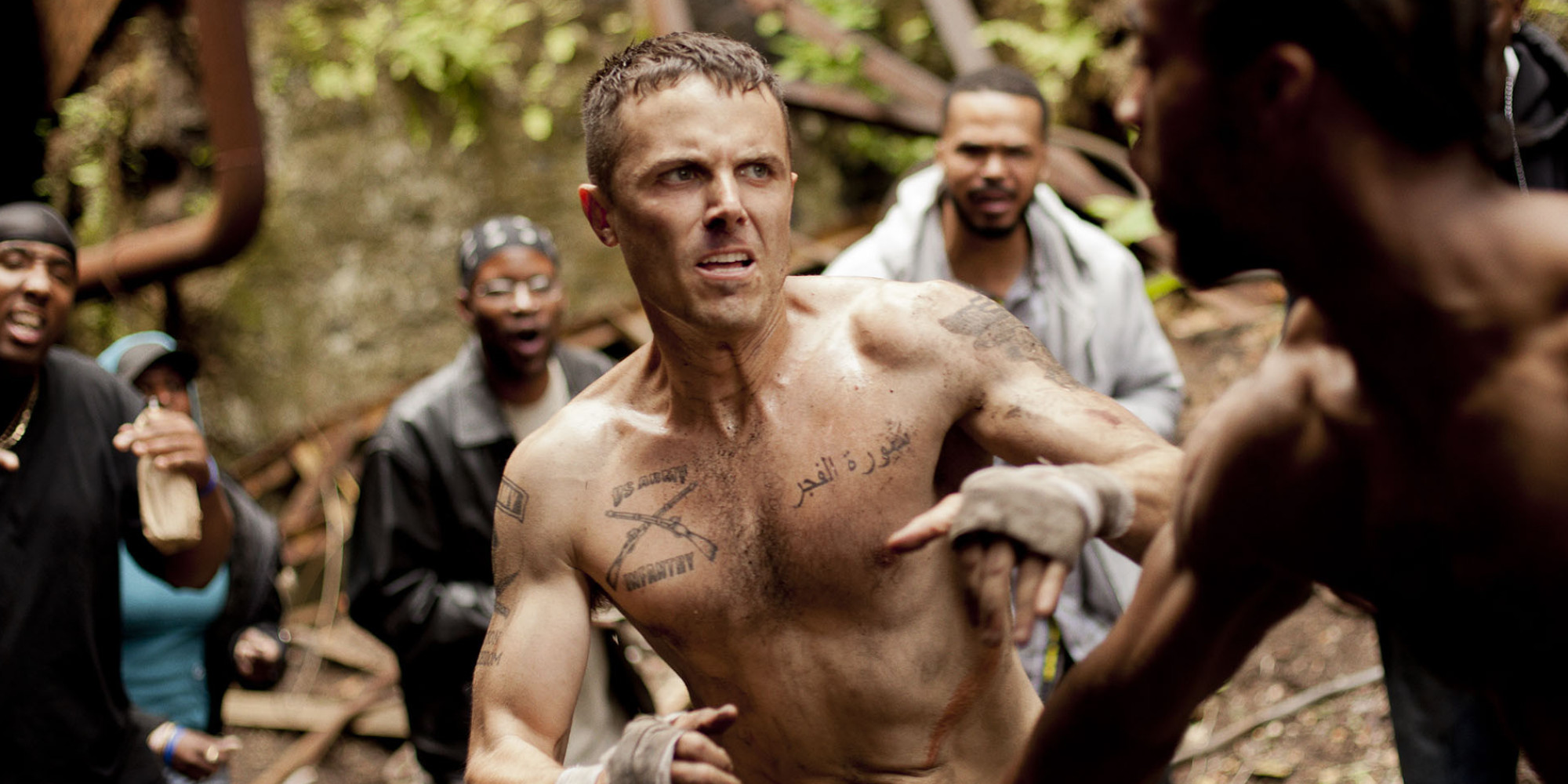
The film opens with an comfortable scene where Harlan DeGroat (Woody Harrelson), is at a drive in theater with his date. He turns into Woody Harrelson, and argues with his date, before beating a man, and walking out. Cut to Russel's introduction, working in a steel mill in Pennsylvania. He leaves work, and find that his brother, Rodney (Casey Affleck), is gambling on races, and in debt to a local loan shark. There is an immediate connection between the two, and their relationship is setup in mere seconds. Russel pays part of Rodney's debt to John Petty (Willem Dafoe) some time later, and we even meet Russel's girlfriend Lena (Zoe Saldana) in between. It's a tightly paced first act that lands Russel in prison for drunk driving. When he is release, Russel learns that Rodney has gotten involved with underground fighting to pay off his debts to Petty.

I had this horrible dream that I was dating someone who couldn't emote.
If I have any issue with the story, it is that the first act can seem a little flaky at first. With Russel ending up in jail only minutes into the film, and the fact that Russel barely seems drunk when he leaves the bar, the whole movie doesn't seem to know what it is doing for a few minutes. Thankfully, by the time the second act finally finds a pulse, the rest of the film finds a way to make the first act seem worthwhile. However, this still makes the first act weak, because it shouldn't rely on the second act to give it purpose. I will say that the finale is intensely satisfying.

What I find strange is that Out of the Furnace is marketed as a revenge film, but it has more to do with self-absolution following tragedy. Both Russel and Rodney are dealing with their ghosts. While Russel deals with the deaths he caused in his car accident, Rodney is the survivor of four tours of duty in Iraq, and carries gruesome memories that disrupt his performance in fights that he is supposed to be throwing. It's a taut drama, but hardly the thriller that the marketing illustrates.

The first rule of Fight Club is please stop making Fight Club jokes.
Out of the Furnace is probably the most earthy film I've seen this year. A muted color palette tinged with hues of warm yellow are cast on dark colored walls and living areas, and there are moments of high contrast lighting. It's got this brilliant early seventies vibe, all the further augmented with soft focus and a lot of steady handheld photography. There are a few shots that I felt were less than inspired, but aside from those nitpicks, it's a gorgeously shot film. Juxtaposed with a subtle soundtrack of simple guitar lines and sustaining woodwinds and light strings, there are a lot of warm moments with Russel, and sequences of stark desperation with Rodney. I have to give special recognition to the inclusion of Release by Pearl Jam early in the film. In retrospect, that should have told me exactly what kind of movie I was dealing with.

In all seriousness, these guys did more acting in this scene
than what's contained in an entire stack of Man of Steel blu-rays.
Out of the Furnace sees one of Christian Bale's finest performances to date, spoken with great care and more heart than I've ever seen him put into a role. Willem Dafoe proves to slip outside of the loan shark stereotype, and prove to be more likable than Casey Affleck, who still performed extremely well. Woody Harrelson played the typical Woody Harrelson act, but it's still an intense and disturbed performance, and shouldn't be discounted. The writing is top notch, and the experience overall is far more memorable than I'd expected. With a lot of competition in the theaters right now, I can still say that Out of the Furnace is among the best on the big screen right now. 

Friday, November 22, 2013

Review: Catching Fire

by William Hill
★★★½

From the ashes of the Twilight...thing (I refuse to call it a saga), comes The Hunger Games trilogy, the latest young adult fiction sensation which has been compared to Battle Royale, Lord of the Flies, and other subject matter far darker than the young adult label is purported to cover. I read the first volume of the trilogy when I got my Nook last year, since the freebie option was either this, or the aforementioned cheap anti-erotica novel, I opted for the book where teenagers kill each other. Considering the Stephanie Meyers blurb on the back cover, my blood was good and frosty when I opened the glorified HTML file that was siting in solitary on my new eReader, I was surprised to find the story of a strong young woman sticking it to a society of hedonists, while trying to survive a free-for-all battle before getting into a love triangle of what in the buggering hell is this nonsense?

Hardly indicative of the themes of nature of the film.

For those of you who are reading this and still questioning why people are into The Hunger Games franchise, allow me to assuage certain fears. No, this isn't about a love starved idiot who pines for two men while a far greater conflict gets shoved into the background. In fact, the entire love triangle thing was shoved into the first book/film. I'll wrap up my discussion of the first film by saying that it was a well told story with fine performances from most of the cast, and some of the most nauseating photography ever designed to conceal brutal violence. I was thrilled to hear that Gary Ross wasn't returning to shoot the follow-up, and that they were leaving the broken tripod back in the equipment truck. So how does the second act of Suzanne Collin's trilogy translate to film?

Well, I didn't get around to reading this book yet, so there will be no nitpicking.


Catching Fire picks up less than a year after the events of the first film, and Katniss Everdeen (Jennifer Lawrence) is still trying to recover from the grim happenings at the previous year's Hunger Games. Her relationship with Thor's brother, Gale (Liam Hemsworth) is a little bit icy after her claiming her love to Peeta (Josh Hutcherson), and rebellion is on the air. Do you see how long it took me to get to the rebellion part? Well, thankfully they dialed this back quite a bit for the sequel, and it doesn't take long before Katniss and Peeta are off to tour the districts and talk about their victory, and watch people get killed, riots break out, and how their actions in the games are spreading hope among the downtrodden people of the other districts. This doesn't sit well with President Snow (Donald Sutherland), who aims to use the popularity of Ms. Everdeen to silence the cries of revolution. What follows is a thrilling look at how people unite under symbols, and how the media is used to mask the dark world events happening right under our noses. It's smart stuff, however given the nature of the series popularity, I wonder if any of the concepts being introduced in the film are being noticed by the audience it is selling to. The score stirs and stings accordingly, and is decent enough to warrant mentioning. I'd like to have heard the mockingjay call used a melodic cue, but I didn't notice such touches of leitmotif upon my first viewing.

He just wouldn't stop asking them to play the music from Tron: Legacy...
Before I get philosophical, I have to celebrate how well Francis Lawrence has improved on what was done in the first film. The photography is far more competent, and doesn't shy away from the violence by quickly moving it from side to side. Sure, it's not packing Battle Royale levels of blood and gore, but it does a far better job of keeping the worst stuff from PG eyes. The visuals are usually impressive, though some of the CGI is less than attractive. When the Quarter Quell kicks off, and the action picks up, there is a scene with monkeys...it isn't as bad as Kingdom of the Crystal Skull, but it's definitely not a pretty sight compared to the bloom-lit beauty of glossy trains, 1% society, and some glorious landscapes. Extravagant costume design in the Capitol scenes continues to stand out, with some truly eye-catching scenes that are designed to remind us of the gap in the social strata, but still draw attention to the visual design of the film in a great way.


Catching Fire does give the world another reason to say how genuinely talented Jennifer Lawrence really is. While this isn't the meatiest content that she's dealt with (see Winter's Bone, and do it soon), she carries herself through every scene with aplomb. It's easy to relate to her troubles, be it the PTSD behaviors she delivers early in the film, or the stark middle-finger-raising rebelliousness which defines her character in the previous film, as well as the late second act of Catching Fire, she excels as Katniss. Supporting this luminary are decent performances from Hemsworth and Hutcherson. However, Woody Harrelson is still a lot of fun as Woody Harrelson, tumbling through the film as a brilliant raging alcoholic. Donald Sutherland is a fantastic villain, remaining intimidating throughout the film, providing a great specter to hover in the atmosphere.

Ummm...what?
I can't help but call the audience out in regards to the tonal content of the film. Let's start with this little oddity; I work at a drug store, and about two months ago, we received a shipper from Cover Girl marked Catching Fire, and I was more than sickened to find "District Twelve Look" makeup inside. It's blatant mass marketing using a popular brand to sell eyeliner when the source material is starkly anti-commercial. Let's pick this apart: both The Hunger Games and Catching Fire clearly illustrated that there was a deep chasm in the social strata between the districts and the Capitol, where people are starving while they go to work in the mines, but the rich are living extravagant lives of sheer hedonism, where they consume vast amounts of food, and then drink a small beverage that makes them sick so that they can continue to eat. When the distributor breaks out the marketing machine that allows you to buy the look of people who are starving and mining for coal, you begin to wonder what people are actually drawing from this series. Let's take it to the character. Katniss is a strong, independent teenager who would sneak out of the city to hunt so she could better feed her family. She put her name in the drawings for the games several times over to get more bread. I was already irritated that she was pushed into a love triangle in the second act of the book because it didn't make any damned sense. She becomes the icon of rebellion among the poor and downtrodden, because she is rebellious. She doesn't conform to what is expected of her by President Snow and the people of the Capitol. So tell me, how does this films fandom deal with putting on colorful Hunger Games branded eyeliner when thinking of this character as rebellious and anti-conformist?


The short answer? They don't. Despite the best efforts of the books and the film, which both depict the social strata of Panem, the idea of peoples as symbols for rebellion, and that this strong young woman could fight and survive against all odds, the thing I heard most people reacting to while the movie was going was the damned love story. Cynics who are unsure of why people bother with the young adult love story, allow me to tell you that Catching Fire is a strong film, with bold statements to make about cult of personality, how the media projects people, and how those personalities can be illusions. Francis Lawrence has made up for the sins of The Hunger Games, and delivered one hell of a second act in Catching Fire. Check out the first one if you haven't, and go see Catching Fire. It's a great theatrical experience, and a movie that you'll discover is a lot more than it's marketing suggests.

Baby, it ain't over til it's over.
Let's see how Mockingjay translates from the oft panned book to film when it comes out next year. In two parts. Because that's how we do the last part of equally sized books when we adapt them these days.


Friday, May 31, 2013

Review: Now You See Me


by Trevor Kirkendall
★★


Caper films are fun. Even when they’re bad. That’s the simplest explanation I can give for my feelings toward “Now You See Me.” It’s always entertaining when you see a complex scheme pulled off in a film and you’re not quite sure how they got away with it. But when the movie strays off its mark and tries to be something its not, that’s when things come undone. Its the same type of thing that plagues many of Hollywood’s films today. It’d be so nice if the studios just spent a little more of their hard earned cash in the story department, but that’s a long winded conversation for another time.

Four street corner magicians – J. Daniel Atlas (Jesse Eisenberg), Merritt McKinney (Woody Harrelson), Henley Reeves (Isla Fisher) and Jack Wilder (Dave Franco) – are all rounded up by an unseen and unknown individual as the movie begins. Together, they form magic act dubbed The Four Horsemen.

One year later, they are all very famous magicians performing nightly in Las Vegas thanks the backing of millionaire Arthur Tressler (Michael Caine). One night in front of the their live audience, they bring up a man on stage who assists them in robbing millions in euros from a bank in France. This catches the attention of the FBI. Agent Dylan Rhodes (Mark Ruffalo) is assigned to investigate the magicians with the help of a new agent at Interpol, Alma Dray (Mélanie Laurent).

With no evidence to hold them down, the Four Horsemen are released to continue their magical bank-robbing extravaganza. Rhodes, Dray and the rest of the FBI are shadowing them the rest of the way. They’re also being followed by Thaddeus Bradley (Morgan Freeman), famous debunker of magic tricks looking to cash in on exposing how the Four Horsemen pull of their seemingly inexplicable tricks.

What starts as a typical caper film quickly collapses when it tries to add too much to an already crowded screenplay. I’m all for layers in a story that makes it more complex and compelling, but its unnecessary when it starts to take away from the substance of the primary plotline.

On its surface, “Now You See Me” is a typical heist film, much in the same vein as something like “Ocean’s Eleven.” The vast difference between the two films is that “Ocean’s” established a plot, established a motive, gathered the characters together and showed them pulling off the heist. “Now You See Me” works the same way, but feels horribly unnatural.

Motive, for example, is established - at the end. By that time, interest and empathy had dwindled away. Not to mention, the film has shifted its primary focus from the Four Horsemen to the FBI and back again at least two or three times. Its hard to connect with a story when the story itself doesn’t know what it wants to be or who its hero should be.

I feel like this film was put together with too much haste, and that the only reason for making it was to gather a wide range of talented actors and actresses. I never knew who I was rooting for watching all of them on the screen at the same time. None of these actors have ever really played a villainous role so its difficult to see any of them in a negative light, particularly when the screenplay is written with humorous dialogue every other line.

No one seems to flex their acting talents to the best of their abilities. At times it almost feels like Mark Zuckerberg is doing magic tricks alongside Woody Boyd. No one brought anything new to the table that we haven’t already seen from other movies or TV shows.

There’s just too much of a disconnection from beginning to end. And just like all caper movies, the ending is the revelation; how did they do it? While any questions that might pop up throughout the movie seem to have an answer, the big reveal is comically head scratching.

But “Now You See Me” isn’t a total waste. As a sucker for heist movies such as this, I did find the majority of this film relatively enjoyable. The heist is pulled off, money is stolen and you’re left there wondering how. They show how its done, and you’re left amazed. And unlike “Ocean’s Eleven” which shows one heist with one big reveal at the end, “Now You See Me” shows three separate heists. Sure they’re using visual effects and CGI to make the tricks seem real, but that’s what magic is anyway. Just a bunch of illusions to make things look like something unexplainable just happened.

The real magic is how such a large group of talented group of actors were all talked in to performing in such a dull and poorly written film. As entertaining as some parts may be, “Now You See Me” is just another example of how Hollywood still likes to put all their flair before their stories.